
 408-643-0150
 647.954.5202


5 Benefits of Automated Lead Scoring for B2B Teams
If I had to sum it up in one line: automated lead scoring helps me focus sales on the leads most likely to buy, cut wasted follow-up, and improve conversion across the funnel.
Here’s the short version:
- I can rank leads by fit and intent instead of working a flat list
- I can help sales and marketing use the same rules for lead quality
- I can cut manual qualification work and give reps more selling time
- I can improve response time, which matters because replying within 5 minutes can make conversion 21x more likely
- I can use closed-won and closed-lost data to keep scores tied to what leads to revenue
A few numbers stand out:
- 31% higher lead-to-opportunity conversion from AI-driven scoring
- 27% conversion lift in one manufacturing use case
- 2+ hours per day saved for sales teams through AI automation
- Up to 75% more conversions in the first year in some cases
If I’m running a B2B pipeline, that means fewer bad handoffs, fewer low-fit leads hitting sales, and a better shot at turning pipeline into revenue.
Quick Comparison
| Benefit | What it helps me do | What I’d watch |
|---|---|---|
| Better lead priority | Put reps on high-intent, high-fit leads first | Conversion rate by score band |
| Sales and marketing alignment | Use one shared lead standard | MQL acceptance rate |
| Team efficiency and scale | Cut admin work and handle more leads | Time to qualify, rep time spent selling |
| Conversion and revenue impact | Improve follow-up timing and funnel movement | MQL to SQL rate, sales cycle length |
| Data-led score tuning | Keep the model tied to deal outcomes | Close rate, score accuracy |
That’s the core idea: less guessing, more focus, and better use of sales time.
Why Automated Lead Scoring Matters in B2B Marketing
Manual lead scoring is inconsistent by design. One rep may score a lead one way, while another may score the same lead differently. That leads to uneven lead quality and uneven follow-up. It also makes it harder to hit the five-minute response window that can lift conversion. And in B2B, a few minutes can be the difference between a live deal and a cold trail.
Automated scoring cuts out that guesswork. Instead of relying on gut feel, the system uses logic to score both firmographic fit and live behavior. That includes page views, downloaded assets, and email engagement. These signals are tracked all the time, not just when someone fills out a form. Manual scoring is static. Automated scoring updates in real time and can show when a lead is actively evaluating a purchase.
There’s another big win here: alignment. When the scoring model is synced with your CRM, sales and marketing work from the same lead data instead of two slightly different versions of the truth. The model can apply positive or negative attributes based on past conversion patterns. That means negative scoring can automatically screen out job seekers, competitors, and other poor-fit contacts, including up to 40% of a manually “qualified” lead pool.
The payoff shows up where it counts. Companies that use automated lead scoring report higher conversion rates and less wasted prospecting time. As Forrester’s Kelvin Gee puts it, shared data is essential to breaking down B2B marketing silos.
That shared standard is what makes the five benefits below possible.
The first benefit is better prioritization of high-value prospects.
sbb-itb-0bbf42a
1. Better Prioritization of High-Value Prospects
Automated scoring helps B2B teams spot high-intent leads faster. Instead of leaning on a static lead list, sales reps get a predictive score that flags high-intent accounts fast. That shifts how they spend their time. Rather than working through every contact in the queue, they can screen out leads that aren’t ready to buy and put their energy into accounts that are.
Good scoring models also filter out poorly fitting leads. So reps spend more time on contacts that match the ideal customer profile and show clear buying intent. In plain terms, the team stops chasing dead ends and starts working the leads with the best shot at moving forward.
That focus on lead quality also helps sales and marketing get on the same page.
Many sales teams say automated scoring improves prioritization, and companies using intelligence-driven scoring have reported significant increases in conversion rates within the first year. To see if prioritization is improving, track conversion rate and speed to first sales touchpoint.
That shared view of lead quality leads directly to better sales and marketing alignment.
2. Stronger Alignment Between Sales and Marketing on Lead Quality
The biggest point of friction is the sales handoff.
When sales and marketing don’t agree on what counts as a qualified lead, things bog down fast. Follow-up gets delayed, teams argue over lead quality, and deals start slipping through the cracks. Automated lead scoring helps cut through that mess by giving both teams a shared, data-based way to qualify leads. That makes the handoff to sales much cleaner.
Instead of relying on gut instinct, a shared scoring model uses behavioral, firmographic, and historical data to define what constitutes a good lead. And when that model is synced with the CRM, both teams can see lead status in real time. So sales only gets leads after they hit the agreed-upon score.
That score acts like a filter before sales gets involved. Fewer weak-fit leads make it through, which means fewer wasted calls and more sales time spent with people more likely to buy. Companies using intent-based scoring to focus sales efforts have seen major gains in close rates and qualified pipeline (see B2B lead generation strategies).
Cleaner handoffs also reduce manual work, which sets up the efficiency gains for the next benefit.
3. More Efficient Teams and Easier Scaling Through Automation
Cleaner handoffs help. But the bigger win is simple: your team gets more time to sell.
Manual lead qualification eats up hours. Reps have to dig through research, update the CRM, and do early qualification by hand. Automated lead scoring takes that repetitive work off their plate. When it connects to your CRM, scores stay up to date without anyone having to babysit the system.
According to research, sales teams save over two hours a day through AI automation, and using AI in CRM systems can lead to 41% revenue growth per salesperson.
That kind of time savings adds up fast as lead volume grows. Without automation, growth often means hiring more people just to keep the same manual process moving. With automation, the team you already have can handle more leads while maintaining quality. No extra headcount. In one case, a team used automated intent data to increase outreach and opportunity generation without scaling headcount.
To see if your automation is doing its job, track a few key metrics in your CRM or marketing automation dashboard:
| Metric | What It Tells You |
|---|---|
| Time to qualify a lead | How fast inbound leads move from raw contact to scored prospect |
| Sales rep time on admin vs. selling | Whether automation is freeing up capacity for high-value work |
| Team throughput | Overall team output relative to lead volume |
| Marketing cost per qualified lead | Whether automation is lowering cost per qualified lead over time |
That extra capacity can also speed up pipeline velocity. More qualified leads move through the funnel faster, and the team spends less time stuck in admin work.
4. Higher Conversion Rates and Revenue Impact Across the Funnel
That kind of efficiency means a lot more when it leads to revenue.
AI-driven scoring has shown a 31% increase in lead-to-opportunity conversions. A lot of that comes down to timing. If a team responds to a prospect within five minutes, the business is 21 times more likely to convert. That’s a huge gap. Automated systems help close it by alerting reps the moment a lead passes a scoring threshold.
The effect shows up early in the funnel too. One manufacturing company used AI to identify high-intent leads and increased its conversion rate by 27%. The result was a better pipeline, not just a bigger one.
Here’s how to track the impact across the funnel:
| Funnel Stage | Impact of Automated Scoring | Key Metric to Track |
|---|---|---|
| Middle of Funnel (MQL to SQL) | 31% increase in conversion via real-time response | MQL to SQL Conversion Rate |
| Bottom of Funnel (SQL to Close) | 28% to 30% shorter sales cycles by identifying “ready” buyers | Sales Cycle Length |
| Overall Revenue | Up to 2x revenue growth through better prioritization | Pipeline Valuation / ROI |
These results tend to stick when teams keep tuning the scoring model.
5. Data-Driven Decisions and Continuous Score Refinement
Every closed-won and closed-lost deal should feed the model. That’s how AI gets sharper over time. It looks at patterns from past conversions and uses them to assign a more precise buying-propensity score to future prospects. In plain English: the model learns from outcomes, not gut calls.
That matters because plenty of leads look good on paper but never buy. Once the model has enough closed-deal data, it gets better at filtering out weak-fit leads before they reach sales. Closed-lost records are especially useful here. They show what didn’t work, which helps the model spot low-intent patterns that might otherwise slip through.
The main job is to separate intent from activity. A busy lead isn’t always a ready-to-buy lead. So scores should lean on signals tied to proven intent, such as:
- Repeat product-page visits
- High-value downloads
- Video watch time
Use closed-won and closed-lost outcomes to retrain the model regularly. Then track score accuracy, MQL-to-SQL rate, and close rate on a single dashboard. Data-driven lead scoring can increase conversion rates by 75% within the first year of implementation. That same feedback loop also makes the gap between manual scoring and automated scoring a lot easier to spot.
Manual vs. Automated Lead Scoring: A Side-by-Side Comparison
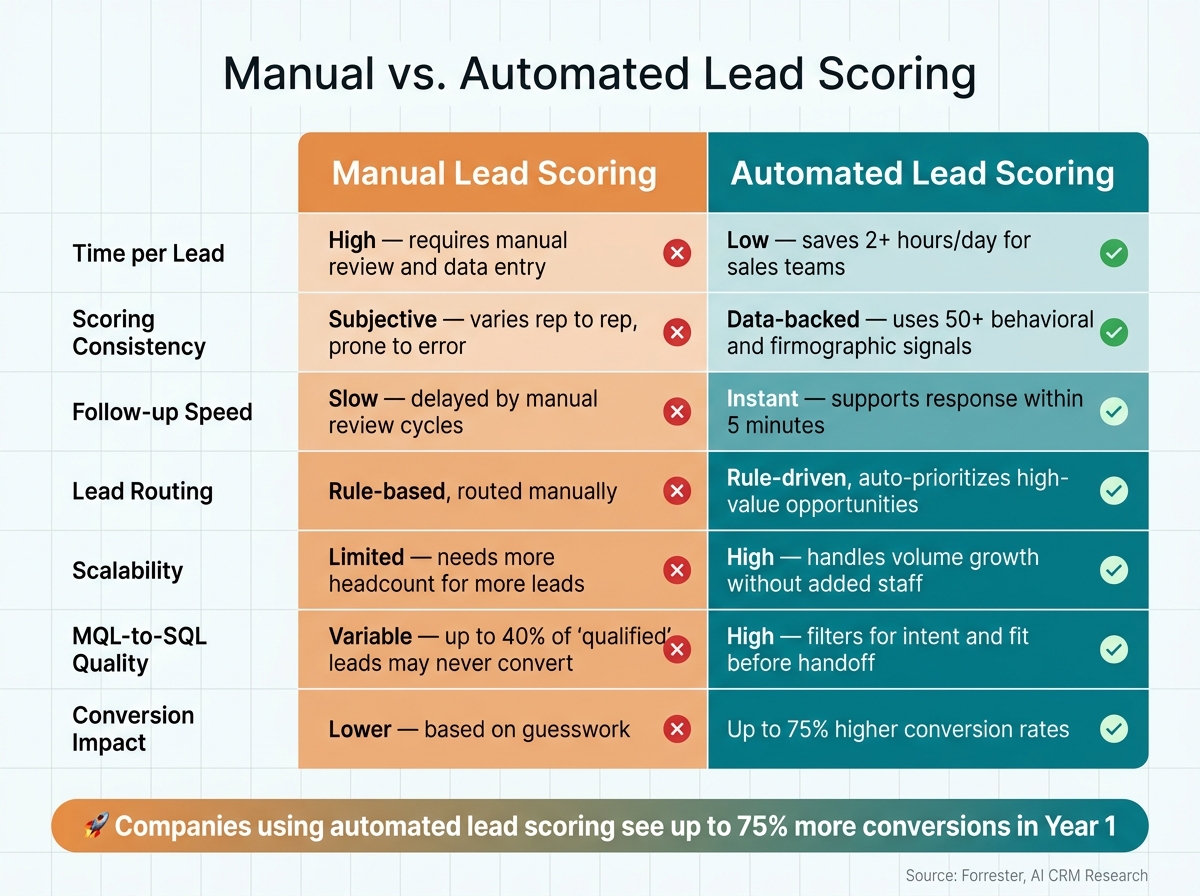
Manual vs. Automated Lead Scoring: Key Stats & Differences
The gap becomes pretty clear when you put manual and automated scoring side by side. Manual scoring tends to slow down as lead volume grows. Automated scoring keeps lead prioritization fast, steady, and repeatable.
| Factor | Manual Lead Scoring | Automated Lead Scoring |
|---|---|---|
| Time per Lead | High; needs manual review and data entry | Low; saves over 2 hours per day for sales teams |
| Scoring Consistency | Subjective; changes from rep to rep and is prone to error | Data-backed; steady across 50+ behavioral and firmographic signals |
| Follow-up Speed | Slow; often held up by manual review cycles | Instant; supports response within 5 minutes |
| Lead Routing | Rule-based; routes leads manually | Rule-driven; automatically prioritizes high-value opportunities |
| Scalability | Limited; needs more headcount to manage more leads | High; handles volume increases without added staff |
| MQL-to-SQL Quality | Variable; up to 40% of “qualified” leads may never convert | High; filters for intent and fit before handoff |
| Conversion Impact | Lower; based on guesswork | 75% higher conversion rates on average |
That’s the big shift: less time spent sorting leads, and more time spent talking to the right ones. Once the scoring model is live, track whether those gains show up in pipeline metrics.
KPIs to Track After Implementing Automated Lead Scoring
Once your system is live, track a small set of KPIs to see if scoring is improving lead quality, follow-up speed, and revenue impact. Pull these from your CRM, marketing automation platform, or GA4 dashboards on a set schedule.
Conversion rate by score band is the clearest signal. It shows whether higher scores line up with stronger buying intent. In a well-set model, conversion should increase as scores rise. If your top-scoring leads aren’t converting at a higher rate than lower-scoring leads, there’s a good chance the model is giving too much weight to activity and not enough to actual purchase intent.
MQL acceptance rate and SQL volume show whether sales trusts what marketing is passing over. If acceptance is low, your scoring rules may not match sales qualification standards. As the model improves, you should see tighter alignment and more qualified leads entering the pipeline.
Time to first follow-up is easy to overlook, but it has a big effect. Track it for leads above your sales-ready threshold. Automated scoring can flag hot leads right away, but that only helps if someone acts on it. If response times are slow, that’s a process problem – not a scoring problem.
Here’s a quick view of the main KPIs and what solid performance tends to look like:
| KPI | Healthy Benchmark | What It Tells You |
|---|---|---|
| Conversion Rate by Score Band | Higher conversion at higher score ranges | Whether scores actually predict buying intent |
| MQL Acceptance Rate | High and rising | Whether sales trusts the lead quality |
| SQL Volume | Rising as more qualified leads enter the funnel | Whether scoring is surfacing enough sales-ready opportunities |
| Time to First Follow-Up | Under 5 minutes for high-score leads | Whether hot leads are being acted on quickly |
| Time to Close | Shorter than baseline | Whether scoring is surfacing leads further along in the buying process |
| Revenue Influenced by Scored Leads | Higher revenue attributed to scored leads | The ultimate proof that better qualification is driving ROI |
Revenue influenced by scored leads is the strongest proof point. It shows whether better qualification is leading to more pipeline value and stronger ROI. These KPIs also help you fine-tune score thresholds, routing rules, and follow-up SLAs.
Conclusion
These five benefits make the case pretty clearly: automated lead scoring helps B2B teams focus on the right accounts, get sales and marketing on the same page, and turn more pipeline into revenue.
When the system works well, sales spends more time on high-intent accounts. Marketing sends better-qualified pipeline. And both teams use the same data instead of working from different assumptions. The result is shorter sales cycles and a clear impact on revenue across the funnel.
Companies that use intelligence-driven scoring see up to 75% more conversions in their first year. That points to a major change in how B2B teams spend time and budget.
The B2B teams that get the most out of automated lead scoring treat it as an ongoing practice rather than a one-time setup: they score leads on real buying signals, then tune the model as those signals shift.
If your sales and marketing teams don’t agree on what a qualified lead looks like, or your CRM data isn’t earning its keep, that’s a fixable problem. WSI Smart Web Marketing helps B2B teams build lead scoring models that connect fit and intent to real revenue outcomes, not just activity. Book a Free Strategy Call to see where your funnel is losing qualified leads.
FAQs
How does automated lead scoring work?
Automated lead scoring uses machine learning and data analysis to rate prospects based on multiple signals, rather than manual review or simple demographic filters.
It brings together firmographic data, such as company size and industry, with behavioral data, such as website visits, content downloads, and email engagement. The system assigns scores to identify the leads most likely to convert, and it improves over time as it learns which prospects become customers.
What data should a lead scoring model use?
An effective lead-scoring model needs data that show both fit and intent.
On the fit side, include firmographic details like company size, industry, and decision-making authority. That helps you see whether a lead matches the kind of customer your team wants to pursue.
On the intent side, look at behavioral signals such as website activity, content downloads, and email engagement. These actions can hint at how interested someone is and how close they may be to taking the next step.
In some sectors, that’s not enough on its own. Technical specifications or application needs can also play a big role, especially when buyers care about exact use cases or product requirements.
For the best accuracy, CRM data should be at least 80% complete and accurate.
How long does it take to see results?
Results depend on two big factors: how fast you put automated lead scoring and AI-driven marketing into place and the length of your B2B sales cycle, which often runs 6 to 18 months.
That said, the upside can be strong. Businesses using AI-driven strategies have reported 27% higher conversion rates and a 75% increase in lead prioritization efficiency. AI can also shorten review cycles, so your team gets insights sooner and can act on them faster.
About the Author
The Best Digital Marketing Insight and Advice
The WSI Digital Marketing Blog is your go-to-place to get tips, tricks and best practices on all things digital
marketing related. Check out our latest posts.
We are committed to protecting your privacy. For more info, please review our Privacy and Cookie Policies. You may unsubscribe at any time.
Don't stop the learning now!

B2B Persona Validation: Key Warning Signs
Signs Your B2B Personas Need Data Validation If your leads look worse, your win rate slips, or sales says “these aren’t our buyers”, your persona may be wrong. I’d validate it now, not after more budget goes to the wrong audience. Here’s the short version: Buyer behavior changes fast. New decision-makers, new objections, and new …
Continue reading “B2B Persona Validation: Key Warning Signs”
READ MORE
AI Readiness Checklist for B2B
AI Readiness Assessment Most AI projects fail when the business is not ready for them first. If I want AI to help my B2B company, I need to check five things before I buy tools: data quality, system connections, repeatable workflows, team skills, and clear rules. Here’s the short version: Data: My CRM and marketing …
Continue reading “AI Readiness Checklist for B2B”
READ MORE
How Educational Content Drives B2B Lead Nurturing
How Educational Content Drives B2B Lead Nurturing Most B2B buyers do their homework before they talk to sales. If your nurture emails push product details too soon, you can lose people before the sales process even starts. I’d sum up the article like this: educational content works when it answers the buyer’s next question, aligns …
Continue reading “How Educational Content Drives B2B Lead Nurturing”
READ MORE