
 408-643-0150
 647.954.5202


How AI Improves Persona-Based Messaging
AI is transforming how businesses communicate by creating dynamic, real-time persona profiles that adapt to audience behavior. Unlike outdated, static personas, AI uses data like website activity, CRM inputs, and engagement patterns to generate accurate insights. This allows marketers to send personalized, targeted messages that resonate with specific decision-makers, such as CFOs focused on ROI or CMOs prioritizing brand impact.
Key takeaways:
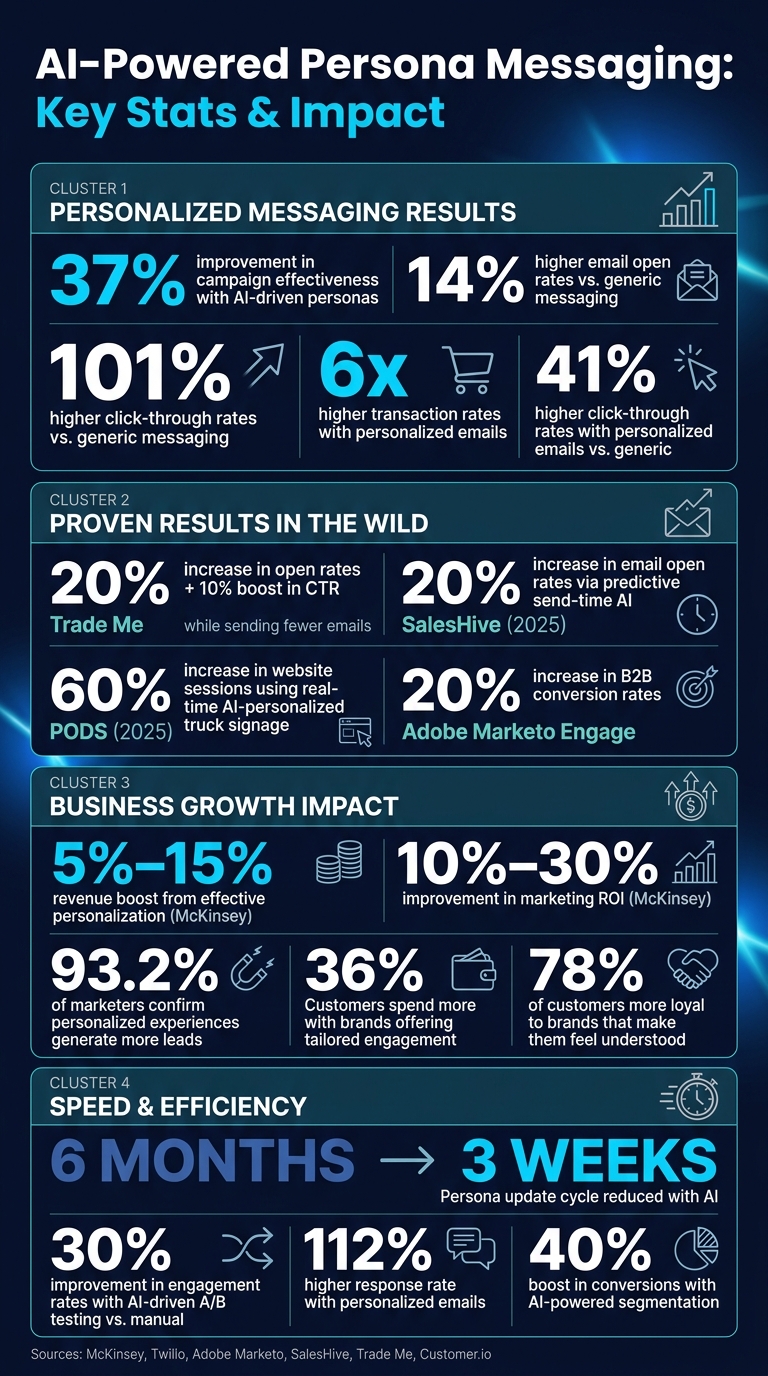
- AI-driven personas update in real-time, improving campaign effectiveness by 37%.
- Personalized messaging increases engagement, with 14% higher open rates and 101% higher click-through rates.
- Tools like NLP and AI business consulting services optimize tone, timing, and content for each persona.
AI-Powered Persona Messaging: Key Stats & Impact
How to Make AI Personas for Marketing
sbb-itb-0bbf42a
Building AI-Driven Personas from Real-Time Data
The way we create personas has evolved dramatically. Traditional methods relied heavily on surveys, interviews, and educated guesses. But AI has flipped the script, using live digital signals to paint a far clearer and more accurate picture of your audience. This modern approach forms the backbone of better engagement and precision, as discussed earlier.
Collecting Behavioral Patterns and Demographics
AI pulls data from a variety of sources: website activity (like scroll depth and click behavior), CRM systems, sales funnel interactions, LinkedIn engagement, email responses, and even external market reports. Using tools like Natural Language Processing (NLP) and clustering algorithms, AI identifies patterns that go beyond surface-level details like job titles. For instance, it can reveal that a specific group of visitors often exits a page after reading the pricing section, suggesting cost concerns rather than disinterest. This level of micro-pattern detection, done at scale, is impossible to achieve manually.
“AI doesn’t just need lots of good data, it needs fresh, relevant, and context-rich data – in an instant.” – Megan DeGruttola, Twilio
Before diving in, it’s critical to audit your CRM data. Outdated or inaccurate fields could lead to flawed AI insights.
Creating Dynamic, Adaptive Persona Profiles
Once the data is collected, AI creates personas that evolve as new insights come in. By analyzing behavioral vectors such as urgency, sensitivity, activity, or preference for efficiency, AI generates highly tailored persona profiles. It goes even further by inferring communication preferences, categorizing individuals into groups such as “Data-Driven Concise”, “Visionary Inspirational”, or “Technical Detailed”. This means even two executives from the same company – a CFO and a VP of Operations – might receive not only different content but also messages crafted in entirely different tones and formats.
“A persona shaped through iterative learning stops behaving like a static PDF and becomes an adaptive system that improves each activation step.” – Anton Mart, M1-Project
Keeping Personas Current with AI Insights
In the past, persona updates might have happened once or twice a year. AI reduces this lag dramatically, bringing the review cycle down from six months to just three weeks. This ensures your messaging stays aligned with shifting audience interests and behaviors.
A great example comes from Trade Me, New Zealand’s largest online auction platform, which serves 650,000 daily visitors. In May 2024, they adopted Twilio Segment‘s CustomerAI Predictions to better anticipate buyer and seller behavior. By leveraging AI-driven insights, they sent more targeted email campaigns and saw a 10% boost in click-through rates and a 20% increase in open rates, all while sending fewer emails.
The secret to keeping these personas sharp lies in a disciplined feedback loop. Identify key behavioral triggers from your AI-generated personas, use them to test campaign ideas, measure the results, and feed that data back into the system. This iterative process not only refines your targeting but also lays the groundwork for automating highly personalized messaging with AI.
Automating Personalized Messaging with AI
Once you’ve established AI-driven personas that are regularly updated, the next step is to let them work for you automatically. This is where AI transitions from providing insights to driving action, delivering highly targeted messages at just the right time. The process builds naturally on the real-time updates of your personas.
AI systems often rely on a two-agent workflow to make this happen. For example, the “Enricher” processes firmographic signals – like job title, company size, and industry – while the “Expert Copywriter” tailors messages to match each persona’s communication style. This ensures that a VP of Engineering receives a detailed, technical explanation, while a CEO gets a concise, strategic overview.
Beyond adjusting tone, AI takes personalization further with dynamic content swapping. Instead of simply inserting a recipient’s first name, entire sections of the message – such as value propositions or case studies – are customized to fit the recipient’s industry or stage in the customer journey. This approach goes well beyond traditional mail-merge techniques. Personalized emails, for example, have been shown to achieve transaction rates six times higher and click-through rates 41% higher than generic ones.
“With AI marketing tools, your business can not only add important context to your customer profiles, but take action to deliver the right message to the right person at the right time on their preferred channel.” – Vanessa Thompson, Vice President of Marketing, Twilio
Timing matters just as much as content. Predictive AI pinpoints the best time to send messages based on past engagement, significantly improving open rates. For instance, in 2025, SalesHive used predictive AI to refine email send times based on recipient activity patterns, which led to a 20% increase in email open rates.
However, it’s crucial to maintain a human touch. AI-generated copy should always be reviewed by a person before it’s sent out. This step ensures the messaging feels natural and avoids sounding overly synthetic. Without this oversight, even the most data-driven messages risk falling into the “uncanny valley” of marketing, where they may feel awkward or manipulative to the recipient.
“The marketer’s job shifts from writing one perfect email to orchestrating a system that writes multiple good emails, each tuned to the reader’s perspective.” – Cody Stover, Director of Demand Gen, Customer.io
Testing and Refining Persona-Based Messaging with AI
Crafting effective persona-based marketing isn’t a one-and-done process. It takes careful testing and ongoing adjustments to get it right. The good news? AI makes this process faster and more effective.
Simulating Audience Reactions with AI
Dynamic AI tools take personalization to the next level by helping you test your messaging before it even goes live. Using sentiment analysis and historical engagement data, AI predicts how a specific persona might respond to different messaging approaches. Large Language Models (LLMs) can rework a single message into various tones – like Data-Driven Concise, Visionary Inspirational, or Technical Detailed – allowing marketers to test which style resonates most with each audience segment.
Here’s a real-world example: Social Trait has created persona-driven AI agents that mimic diverse consumer groups. This lets brands test campaigns in real-time before launch, reducing the risk of misfires. As Vivek Kumar, CEO of Social Trait, explains:
“Ethical AI isn’t a feature. It’s a framework – which we must build now, not retroactively.”
By running these pre-launch simulations, teams can make smarter choices about which version of their message will hit the mark.
Ongoing Message Refinement for Better Results
Once your campaign is live, AI takes on a different role – refining and optimizing your messaging continuously. Through automated A/B testing, AI generates multiple variations of subject lines, calls-to-action (CTAs), and body copy, analyzing real-time data to determine what performs best for each persona. This approach has been shown to improve engagement rates by up to 30% compared to traditional manual testing methods.
For meaningful results, it’s essential to test one variable at a time – like the subject line or the timing of an email – so you can pinpoint what’s driving performance. Monitoring key metrics such as open rates, click-through rates, and unsubscribe rates on a weekly basis can also help identify when personalization efforts might be crossing the line.
As Jamie Pagan, Director of Brand & Content, puts it:
“AI in marketing is like protein powder in nutrition – it’s a powerful supplement, not a magic fix. It helps scale what already works, making strong strategies even stronger, but it won’t turn bad marketing into good marketing.”
The results speak for themselves. Adobe’s use of AI within Marketo Engage enabled B2B marketers to see up to a 20% increase in conversion rates by automating persona-specific audience segmentation. Campaigns that leverage AI-driven insights also consistently deliver 14% higher open rates and 101% higher click-through rates compared to generic messaging.
This cycle of testing and refining doesn’t just improve individual campaigns – it feeds back into your AI-generated personas, ensuring your messaging stays sharp and relevant over time. With AI, persona-based marketing becomes a continuous loop of learning and improvement.
Key Benefits of AI in Persona-Based Messaging
AI has reshaped how businesses approach persona-based messaging, delivering measurable advantages in B2B communications. One of the standout benefits is the ability to drive higher revenue and ROI. According to McKinsey, effective personalization can boost revenue by 5%–15% and improve marketing ROI by 10%–30%. Additionally, a staggering 93.2% of marketers report that personalized or segmented experiences generate more leads and purchases. These metrics highlight the potential for significant business growth when AI is integrated into marketing strategies.
Another major advantage is the time saved on critical tasks like defining your target audience, crafting copy, and analyzing campaigns. What used to take days can now be achieved in hours – or even minutes. Take PODS as an example: in early 2025, they used generative AI to create thousands of personalized messages for digital signs on their trucks in New York City. These messages were updated in real time based on the neighborhoods the trucks were passing through, leading to a 60% increase in website sessions. Achieving this level of dynamic, location-specific personalization would be nearly impossible without AI.
Personalization also directly impacts consumer behavior. Customers spend, on average, 36% more with brands that offer tailored engagement, and 78% are more likely to remain loyal to brands that make them feel understood. AI enhances this by analyzing behavioral signals like scroll depth, dwell time, and repeated product comparisons. The result? Messaging that feels highly relevant and engaging, without crossing the line into being overly intrusive.
Traditional vs. AI Persona Methods
The shift from traditional to AI-powered persona methods is transformative. Here’s how they compare:
| Benefit | Traditional Method | AI-Enhanced Method |
|---|---|---|
| Persona Creation | Relies on manual research over long periods | Automates analysis to keep profiles updated in real time |
| Message Personalization | Requires manual rewrites for broad audience groups | Instantly generates content tailored to each persona |
| Testing | Focuses on feedback from surveys and focus groups | Simulates audience reactions for faster insights |
| Optimization | Conducted through periodic reviews | Continuously adapts and refines messaging |
This comparison underscores how AI streamlines and improves every step of persona development. Traditional methods rely on broad demographic data and infrequent updates, whereas AI creates dynamic, multidimensional profiles that evolve with real-time behavioral insights. By aligning messaging with these constantly updated profiles, businesses can maintain stronger engagement and achieve measurable ROI.
Adding AI Personas to B2B Marketing Workflows
When it comes to incorporating AI personas into your marketing and sales processes, a structured 30-day rollout plan can make all the difference. Start by dedicating the first week to auditing your CRM data and identifying any gaps in the signals you’re tracking. In weeks two and three, focus on creating persona templates and running pilot tests with a high-intent audience – like visitors to your pricing page. By week four, you’ll be ready for a full-scale deployment. This phased approach ensures your data is accurate and avoids amplifying any errors. Once the groundwork is solid, follow these steps to seamlessly integrate AI personas into your workflow:
| Step | Focus Area | Key Activity |
|---|---|---|
| 1 | Data Foundation | Audit CRM data and identify signal gaps |
| 2 | Signal Mapping | Connect business triggers (e.g., funding rounds, new hires) to value propositions |
| 3 | AI Synthesis | Use NLP to create a “digital twin” persona profile |
| 4 | Workflow Embed | Make the persona an active variable in your content automation |
| 5 | Human Review | Refine AI-generated drafts for tone, brand alignment, and factual accuracy |
A critical part of this process is the human review. While AI can handle much of the heavy lifting, elements like tone, brand consistency, and nuanced decision-making still require human oversight. Alexander J. Brooks, Head of Growth at Bardeen, highlights this balance:
“AI isn’t great at creating outreach strategies, it can be effective at implementing them.” – Alexander J. Brooks
The benefits of integrating AI personas are clear. For instance, personalized emails can achieve a 112% higher response rate, while AI-powered segmentation has been shown to boost conversions by 40%. By embedding dynamic personas into your workflows, you can amplify these results and achieve measurable improvements in both engagement and conversion rates.
How WSI Smart Web Marketing Supports AI Adoption
For small and mid-sized B2B businesses, moving from understanding AI personas to deploying them effectively can feel overwhelming. That’s where WSI Smart Web Marketing steps in, offering expertise in both AI implementation and strategic marketing.
Their approach starts with in-depth persona development and empathy mapping, forming the foundation of a broader business strategy. AI tools are then integrated into key areas such as content marketing, SEO, marketing automation, and campaign optimization. This ensures that each persona directly informs the messaging delivered to potential customers. For businesses needing high-level guidance without hiring a full-time CMO, WSI’s Fractional CMO service provides strategic oversight to keep AI initiatives aligned with overall business goals. Every solution is tailored to the client’s specific industry, budget, and growth targets.
Conclusion
AI has reshaped the way marketers approach persona-based messaging. Instead of relying on static, outdated profiles, businesses can now create dynamic personas that evolve in real time, respond to behavioral cues, and deliver personalized content at scale. The results speak for themselves: personalized strategies significantly boost both engagement and revenue.
This transformation isn’t just about technology – it’s about strategy. As the team at Customer.io explains:
“The marketer’s job shifts from writing one perfect email to orchestrating a system that writes multiple good emails, each tuned to the reader’s perspective.”
However, AI thrives when paired with clean data, a clear plan, and consistent human oversight. While technology handles the heavy lifting, it’s the human touch that ensures messages remain authentic and aligned with the brand. This blend of automation and human input keeps persona-based messaging evolving in the right direction.
For small and mid-sized B2B businesses ready to embrace AI-driven messaging, WSI Smart Web Marketing offers the expertise to make it happen. They combine AI tools with strategic marketing to build systems that deliver measurable results. Whether it’s starting with a data audit or optimizing an existing workflow, having a trusted partner can make the transition smoother and more impactful.
Businesses that take action now – crafting smarter personas, automating thoughtfully, and refining their approach – will rise above the noise of generic messaging.
FAQs
What data do I need to build AI-driven personas?
To build AI-driven personas, start by gathering data that mirrors your audience’s behaviors, preferences, and demographics. Focus on behavioral insights, such as website visits, engagement trends, and purchase histories. Pair this with demographic details like job roles, company size, industry, and geographic location.
Adding real-time data, such as recent user interactions or email response patterns, ensures your personas remain dynamic and up to date. This combination helps AI create highly accurate profiles, making it easier to tailor your messaging to specific audience segments.
How do I keep AI personalization from sounding creepy or fake?
To keep AI personalization from feeling intrusive or insincere, prioritize genuine interactions and respect user boundaries. Be upfront about the role AI plays, and always provide users with the option to opt out if they choose. When using real-time data such as location or time, apply it carefully to add relevance without crossing personal boundaries. Steer clear of overly detailed or excessively personal messages – focus on empathy and meaningful relevance. This approach helps build trust and ensures interactions feel natural and comfortable for users.
What’s the fastest way to start using AI personas in my B2B marketing?
To get AI personas up and running in your B2B marketing strategy, the fastest route is through AI tools that handle segmentation and data analysis. These tools can help you build detailed customer profiles with minimal hassle.
Start by examining prospect activity – things like website visits, social media interactions, and other engagement metrics. Then, use AI platforms to automate persona creation. These platforms generate dynamic, data-driven profiles that allow you to scale personalized campaigns with ease.
The beauty of this method? It reduces manual work while speeding up your results.
About the Author
The Best Digital Marketing Insight and Advice
The WSI Digital Marketing Blog is your go-to-place to get tips, tricks and best practices on all things digital
marketing related. Check out our latest posts.
We are committed to protecting your privacy. For more info, please review our Privacy and Cookie Policies. You may unsubscribe at any time.
Don't stop the learning now!

B2B Persona Validation: Key Warning Signs
Signs Your B2B Personas Need Data Validation If your leads look worse, your win rate slips, or sales says “these aren’t our buyers”, your persona may be wrong. I’d validate it now, not after more budget goes to the wrong audience. Here’s the short version: Buyer behavior changes fast. New decision-makers, new objections, and new …
Continue reading “B2B Persona Validation: Key Warning Signs”
READ MORE
Lead Scoring Benefits for B2B Teams
5 Benefits of Automated Lead Scoring for B2B Teams If I had to sum it up in one line: automated lead scoring helps me focus sales on the leads most likely to buy, cut wasted follow-up, and improve conversion across the funnel. Here’s the short version: I can rank leads by fit and intent instead …
Continue reading “Lead Scoring Benefits for B2B Teams”
READ MORE
AI Readiness Checklist for B2B
AI Readiness Assessment Most AI projects fail when the business is not ready for them first. If I want AI to help my B2B company, I need to check five things before I buy tools: data quality, system connections, repeatable workflows, team skills, and clear rules. Here’s the short version: Data: My CRM and marketing …
Continue reading “AI Readiness Checklist for B2B”
READ MORE