
 408-643-0150
 647.954.5202


Lead Nurturing Content by Buyer Journey Stage
Most B2B content fails for one simple reason: it shows up at the wrong time. Send product-heavy content too early, and you lose trust. Wait too long to show proof, and you lose deals.
The fix is straightforward: match content to the buyer’s stage.
- Awareness: help buyers name the problem
- Consideration: help them compare options
- Decision: help them justify the purchase
- Sales follow-up: help them clear final objections and move forward
The core principle is simple: stage-matched nurture content moves leads forward. The data backs it up. Well-sequenced nurture programs drive 50% more sales-ready leads, cut cost per lead by 33%, and produce 47% larger deals. It matters even more given that about 70% of B2B research happens before sales ever gets involved.
Key takeaways to put into practice:
- Stop leading with demos and feature lists
- Fill mid-funnel gaps before pushing more top-funnel traffic
- Build late-stage assets like ROI pages, comparison pages, and proof-driven case studies
- Measure stage movement, pipeline, win rate, and sales cycle length – not just raw lead volume
In short: give buyers the right message in the right order: problem, options, proof, then action.
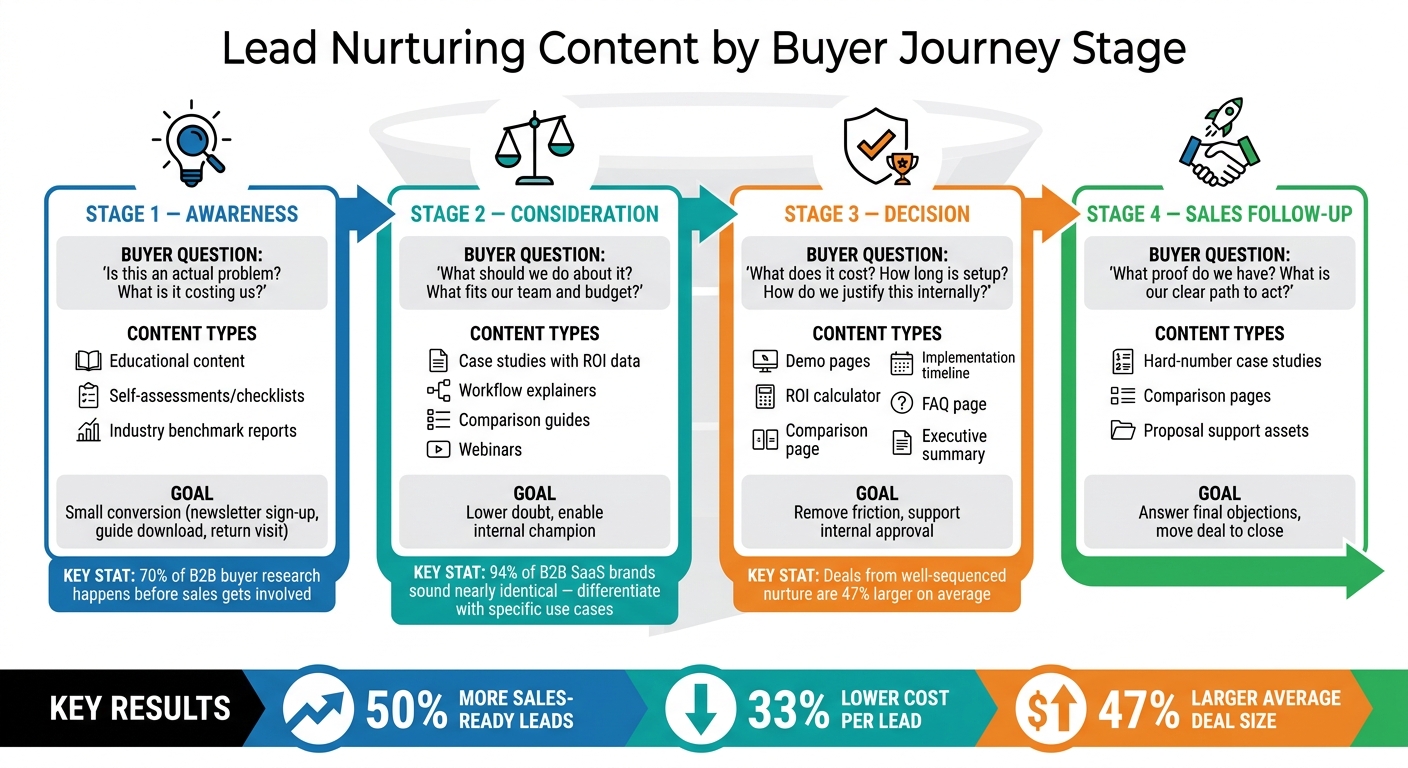
B2B Lead Nurturing Content by Buyer Journey Stage
Awareness Stage Checklist: Content for Buyers Discovering Their Problem
What Buyers Need at the Awareness Stage
At this stage, buyers aren’t hunting for a vendor. They just know something feels off, and they haven’t put a clean label on it yet.
Your job is simple: help them define the problem clearly, without mentioning any product. That first touch matters. Buyers here are asking things like: Is this an actual problem or just growing pains? How bad is it? What is it costing us?
The best content answers those questions in plain business language. Talk about lost hours, missed revenue, and avoidable costs. That’s what builds trust.
Content Checklist for Awareness Campaigns
The best formats here are educational and easy to get through. Educate first. Convert later.
Good awareness content usually focuses on one pain point at a time. It may also include self-assessments or checklists that help buyers gauge how serious the issue is, plus industry benchmark reports that provide context.
The goal isn’t a big conversion. It’s a small conversion:
- A newsletter sign-up
- A guide download
- A return visit
| Content Type | Primary Purpose | Small Conversion Goal |
|---|---|---|
| Educational content | Name and frame the problem | Return visit |
| Self-assessments / checklists | Help buyers qualify their own pain | Download |
| Industry benchmark reports | Provide data context | Download, email sign-up |
Goals for Awareness Stage Content
The goals at this stage are pretty direct: attract the right audience through buyer persona development, build problem awareness, and pick up early engagement signals.
That focus on education isn’t just a nice idea. 79% of the most successful B2B content marketers rank education as their top content goal, above direct sales or promotions.
That makes sense. About 70% of B2B buyer research happens before a buyer talks to sales. If your awareness content is thin or stuffed with product talk, you’re missing the stage that shapes how buyers think about the problem in the first place.
Common Awareness Stage Gaps to Fix
The most common mistake is talking about the product too soon. If your nurture emails jump into features or pricing by message two, part of that audience is already gone. Content at this stage should not sound like a pitch. If it does, trust slips fast.
Other gaps show up again and again in content audits. One is generic messaging that isn’t tied to a single use case. Another is missing diagnostic content that helps buyers understand the issue’s business impact. Without that, they don’t have a clear way to size up what the problem is costing them in lost hours, missed revenue, or avoidable costs.
“Educational marketing is rooted in the principle of adding value before extracting value.” – Howard Walker, Owner, WSI Smart Web Marketing
Weak attribution is another issue. B2B sales cycles often run from 6 to 18 months, so many teams struggle to tie early educational content to closed deals.
Once buyers can name the problem, move them to content that compares approaches and tradeoffs.
sbb-itb-0bbf42a
Consideration Stage Checklist: Content for Buyers Evaluating Their Options
What Buyers Need at the Consideration Stage
Once buyers understand the problem, they stop asking, “What’s going wrong?” and start asking, “What should we do about it?”
This is the evaluation phase. Buyers want to compare paths, see the tradeoffs, and figure out what fits their team, budget, and effort level. In B2B, that usually means more than one person is involved. Operations may care about workflow fit. IT may look at setup and systems. Finance wants a clear business case. Leadership wants to know if the direction makes sense.
That’s why consideration-stage content works best when it does three things well: it compares options, shows proof, and explains what rollout looks like.
Content Checklist for Consideration Campaigns
At this stage, buyers need content that helps them weigh fit, cost, and approach as part of their B2B lead generation strategies. The formats that tend to work best are case studies with clear, measurable results, white papers, solution one-pagers, workflow explainers, and webinars that stack different approaches side by side.
Use these formats to answer the questions each stakeholder group is asking.
| Content Type | Who It Helps Most | What It Answers |
|---|---|---|
| Case studies with specific numerical ROI data | Finance / CFO | “Can we justify this investment?” |
| Workflow explainers / solution one-pagers | Operations / IT | “How does this fit into their workflow?” |
| Comparison guides / methodology breakdowns | Cross-functional evaluators | “What are our real options here?” |
| Webinars comparing approaches | Executive / strategic leads | “What’s the right direction for us?” |
Goals for Consideration Stage Content
The goal here is not to close the deal. It’s to lower doubt and help the buyer’s internal champion explain the case to everyone else involved.
When content does that job well, qualified prospects are more likely to move toward a demo, a consultation, or a deeper sales conversation.
The data supports that pattern. Companies that sequence nurture content the right way with education first, then proof, then action, generate 50% more sales-ready leads at a 33% lower cost. Deals touched by well-built nurture sequences are also 47% larger on average.
Common Consideration Stage Gaps to Fix
One of the biggest problems is missing mid-funnel content. Many nurture sequences jump from awareness content straight to product demos and skip the comparison step. That’s a mistake because about 70% of B2B buyer research is done before a prospect ever talks to sales. If buyers can’t find content that helps them evaluate options on their own, they may pause the process or get that information elsewhere.
Another issue is vague positioning. With 94% of B2B SaaS brands sounding nearly identical, consideration-stage content tied to a clear use case – one industry, one workflow, one measurable problem – is far more useful and helps your company stand out.
Thin proof is another weak spot. A case study without hard numbers won’t help someone win budget approval. Each consideration-stage case study should show measurable results and a timeframe. If the proof is soft, or the use case is too broad, buyers can’t tell which option fits their process or budget.
Once buyers can compare options with confidence, the next step is content that reduces final risk and supports the buying decision.
Decision Stage Checklist: Content That Builds Purchase Confidence
What Buyers Need at the Decision Stage
At the decision stage, buyers already know the problem and the main options. Now they need proof, clarity, and cover for the internal approval process.
The questions get pretty direct at this point: What does it cost? How long will setup take? What does onboarding look like? What happens if something breaks? Is it secure? How do we explain this to the CFO or procurement team?
In many cases, the internal champion does more than evaluate the product. They’re also trying to sell the decision inside their own company to finance, procurement, or senior leaders. Your content should make that job easier. Each asset should answer a last-minute objection or help support internal approval.
Content Checklist for Decision Stage Campaigns
Decision-stage content isn’t about publishing more. It’s about having the right assets in place to answer final concerns and lower purchase risk.
| Asset | Primary Purpose | Who It’s Built For |
|---|---|---|
| Demo page (pain-focused, not feature-focused) | Show how the solution solves one specific problem | Evaluators and champions |
| Comparison page | Help buyers make the final shortlist decision | Evaluators and buying committee |
| ROI calculator or ROI summary page | Quantify the financial return in dollars | CFO / finance stakeholders |
| Detailed implementation timeline | Show what rollout, onboarding, and support actually look like | Operations / IT |
| FAQ page covering pricing, security, onboarding, and support | Answer late-stage objections quickly | All decision stakeholders |
| Executive summary or business case template | Help the champion present the investment internally | C-suite / procurement |
| Customer testimonials or short proof clips | Validate the decision with real customer proof | All decision stakeholders |
Lead demo pages with the buyer’s pain point. Then show the exact workflow and outcome.
That shift matters. A late-stage buyer doesn’t want a product tour for its own sake. They want to see, in plain English, how the tool fixes their problem.
These assets should reduce risk, not add more explanation.
Goals for Decision Stage Content
The goal here is simple: remove the friction that keeps a ready buyer from saying yes.
That means:
- addressing cost concerns
- making implementation clear
- giving the internal champion the words and proof they need to get approval
When decision-stage content works, it shortens approval cycles and reduces back-and-forth between sales and the buying committee. The buyer already feels good about the direction. What they need now is enough proof to get the deal through the finish line.
The biggest failure point usually isn’t demand. It’s friction.
Common Decision Stage Gaps to Fix
The most harmful gap is weak ROI justification. A case study without hard numbers – actual dollar savings, percentage efficiency gains, or a clear payback period – usually won’t hold up in a CFO review. Every decision-stage case study should include specific financial or operational metrics that help buyers build the business case.
Another common issue is demo content that’s packed with features but disconnected from the buyer’s actual problem. When demos focus on product capabilities instead of use cases, buyers can walk away thinking, Looks nice, but will this fit our workflow?
Pricing, security, and support are another sticking point. If buyers can’t confirm those basics fast, they often pause the process or bring in more internal questions. FAQ content and clear late-stage pages help remove that uncertainty.
Don’t scale traffic until the demo, comparison, and ROI pages are ready to convert late-stage interest.
Align sales talk tracks with website messaging. Keep a clear comparison page available for buyers who are narrowing down options.
Once these assets are in place, use sales follow-up content to keep the buying process moving.
Sales Follow-Up and Next Steps: Closing Content Gaps Across the Buyer Journey
Sales Follow-Up Asset Checklist
After a demo, proposal request, or pricing talk, the goal shifts. At that point, the buyer usually doesn’t need more top-level education. They need proof, then a clear path to act.
That’s why late-stage assets matter so much. Case studies with hard numbers, comparison pages, and proposal support help answer the last round of objections. And the best version of those assets usually comes straight from customer calls. When you use the same words buyers already use and trust, the content feels a lot more convincing.
Buyer Journey Content Audit Checklist
A simple way to spot gaps fast is to use a two-axis matrix: defining your target audience across the top and journey stages down the side. Stick with the same Awareness, Consideration, and Decision labels from the checklist above. Then map every asset you already have. Gaps tend to stand out almost right away.
As you review the matrix, watch for a few common problems:
- Missing stages for a given persona
- Duplicate assets that do the same job
- Broken sequences that jump from education straight to a pitch
- Missing comparison content in the middle of the journey
“The programs that stall usually break at the seams between these stages: content that jumps straight to product pitches, a gap where mid-funnel comparison content should be, or a sequence that goes quiet right when a buyer needs the strongest proof point.” – Howard Walker
If you’re deciding what to fix first, start at the end of the journey. Demo pages, hard-number case studies, and comparison pages tend to have the biggest impact.
How to Measure Content Performance by Stage
Each stage of the buyer journey needs its own metrics. If you roll everything up into one “leads generated” number, you miss what’s pulling its weight and what’s not.
| Journey Stage | Key Metrics to Track |
|---|---|
| Awareness | Profile views, follower growth, connection acceptance rates, organic traffic to educational content |
| Consideration | Email open rates, content downloads, time spent on comparison pages |
| Decision | Demo requests, discovery calls scheduled, case study downloads with specific ROI numbers, engagement with proposal support decks |
| Overall | Qualified pipeline, SQLs, win rate, average deal size, revenue contribution, sales cycle length |
A better approach is to track stage progression, qualified pipeline, and the conversion from nurture to sales, instead of leaning on MQL volume alone.
That matters even more in B2B, where buying cycles often stretch from 6 to 18 months. In a long sales cycle, attribution gets messy fast. One practical fix is to measure how buyers move from one stage to the next, then pair that with the conversion rate from nurture email to sales conversation.
Key Takeaways for B2B Content Planning
The sequence is pretty simple: match content to the buyer stage by giving them the problem first, then options, then proof. Put late-stage assets in place before putting more effort into awareness. Use customer language in sales support, not internal jargon. And when you measure results, focus on stage progression, qualified pipeline, revenue, and sales cycle length.
Ready to Close the Gaps in Your Buyer Journey?
Most B2B companies have some content for the awareness stage and plenty of collateral for the sales team — but the mid-funnel and late-stage assets that actually move deals forward are often missing. WSI Smart Web Marketing helps B2B technology manufacturers map, build, and measure lead nurturing content across every stage of the buyer journey, using our ProTech Growth Engine methodology.
If you’re not sure where your content library has gaps — or how your current nurture sequence is performing — let’s talk it through.
Contact WSI Smart Web Marketing today to start closing the gaps in your buyer journey.
FAQs
How do I map content to each buyer stage?
Start with buyer personas. Then use a simple content mapping matrix to line up each persona with each stage of the buyer journey.
- Awareness: educational, vendor-neutral content like blog posts, how-to guides, and infographics
- Consideration: case studies, webinars, white papers, and comparison guides
- Decision: ROI calculators, pricing sheets, testimonials, and product demos
After that, audit your content for gaps. Focus first on the points where buyers tend to stall, then tag each asset by persona and stage.
It helps to think of this like a map: the persona tells you who the content is for, and the journey stage tells you when it matters. Without both, even solid content can miss the mark.
Which content gaps should I fix first?
Focus first on the biggest gaps in your content library, especially comparison, proof, and ROI content if those parts of the buyer journey are missing.
Start with a content audit and map each asset to a buyer stage. The blank spots usually show where prospects get stuck or drop off. Then bring in sales feedback to spot common questions, objections, or deal blockers.
If you’re building from scratch, begin with awareness-stage educational content. After that, move into decision-stage assets.
How should I measure nurture content performance?
Focus less on vanity metrics like pageviews. Put more attention on how people move through the funnel and what that means for revenue.
Track awareness with organic sessions, traffic growth, and click-through rates. For consideration, watch email engagement, downloads, webinar participation, and MQL-to-SQL conversion rates. At the decision stage, look at demo requests, trial sign-ups, and pricing page visits.
To tie it all back to pipeline and revenue, connect your web analytics to your CRM. Use consistent UTM parameters and multi-touch attribution so you can measure both sourced and influenced pipeline revenue.
About the Author
The Best Digital Marketing Insight and Advice
The WSI Digital Marketing Blog is your go-to-place to get tips, tricks and best practices on all things digital
marketing related. Check out our latest posts.
We are committed to protecting your privacy. For more info, please review our Privacy and Cookie Policies. You may unsubscribe at any time.
Don't stop the learning now!

Predictive Lead Scoring for B2B
Role of Predictive Analytics in B2B Lead Generation Most B2B lead generation strategies don’t fail because of a lead problem. They have a lead quality problem. If only 27% of marketing-passed leads are ready for sales, and poor qualification can cost a mid-sized business up to $2.8 million per year, then scoring leads better isn’t …
Continue reading “Predictive Lead Scoring for B2B”
READ MORE
How To Align Content Calendars With Business Goals
How To Align Content Calendars With Business Goals A content calendar should do more than fill publish dates. It should help drive pipeline, revenue, sales speed, or retention. When I align a calendar to business goals, I keep it simple: I start with one business goal I tie each asset to one audience, one funnel …
Continue reading “How To Align Content Calendars With Business Goals”
READ MORE
Half of Website Traffic Isn’t Human. It’s time to Rethink Performance Metrics.
Bots now account for 51% of global web traffic, surpassing human users. This shift impacts how businesses measure website performance and make decisions. Here’s why it matters: Bad bots (37% of traffic) inflate metrics, skew data, and make it harder to identify real user behavior. AI crawlers from companies like Meta, Google, and OpenAI consume …
Continue reading “Half of Website Traffic Isn’t Human. It’s time to Rethink Performance Metrics.”
READ MORE